MiroFish: The AI That Simulates the Future Before It Happens
A 20-year-old built a tool that can predict how the world reacts to anything, and he went from intern to CEO overnight.
The Story Behind the Tool
A senior undergraduate student in China known online as "Baifu," had already made waves in the developer world in late 2025 when his first open-source project, BettaFish , a multi-agent tool for analyzing public sentiment, shot to the top of GitHub's global trending list and racked up 20,000 stars in a single week.
That caught the attention of Chen Tianqiao, founder of Shanda Group and formerly China's richest man, who invited Guo for an internship with a simple brief: build whatever you want. Utilizing vibe coding, he produced a fully functional version of his next project in just ten days.
That project was MiroFish.
 MiroFish Logo Source

Within 24 hours of showing an early demo, Chen committed 30 million RMB (roughly $4.3 million USD) to incubate it. Guo went from intern to CEO overnight. When MiroFish launched publicly in early March 2026, it hit the number one spot on GitHub's global trending list, sitting above repositories from OpenAI, Google, and Microsoft, and accumulated over 33,000 stars in 2 weeks, which is insane as most repos never see 1000.
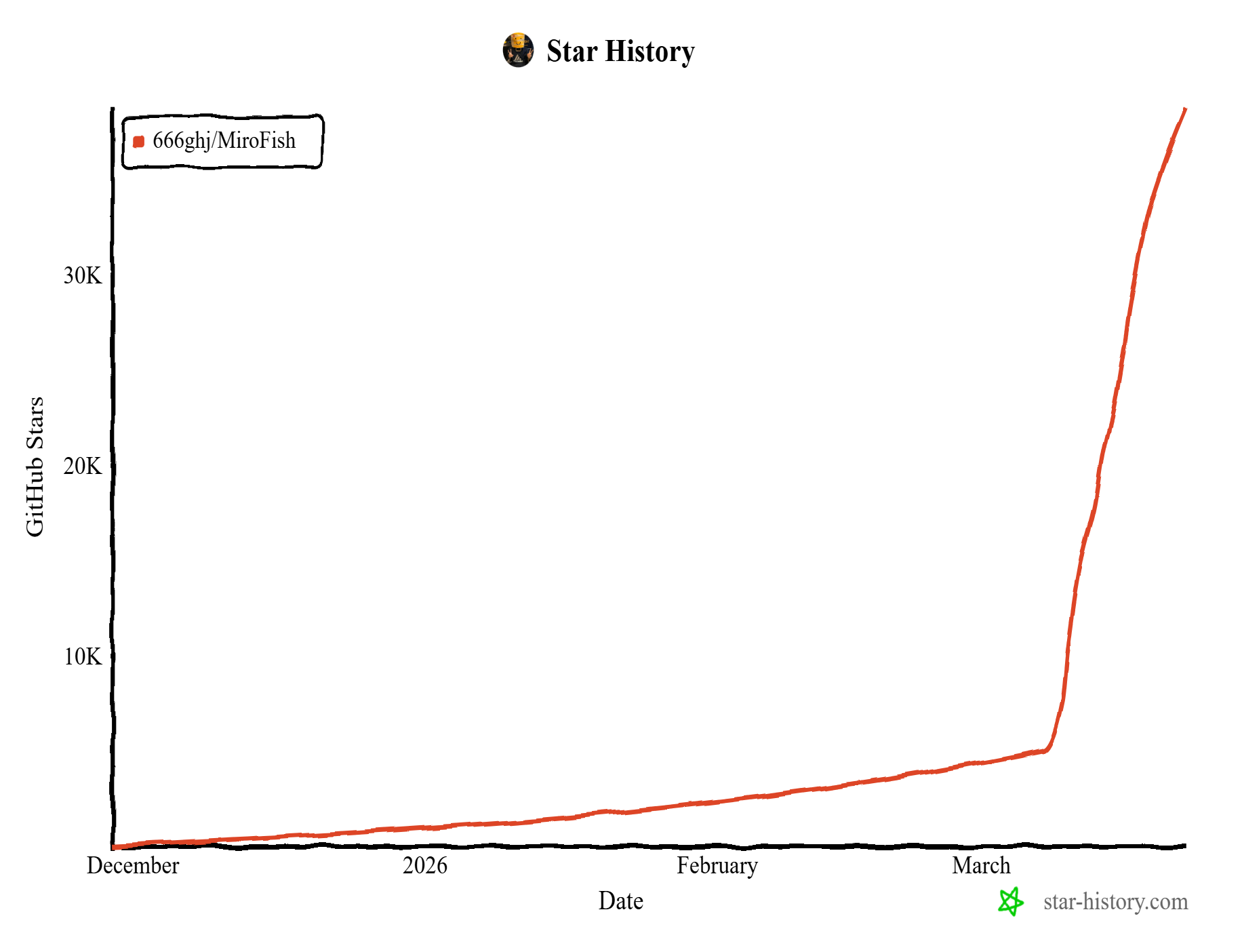 Mirofish Github Star History Source
What Is MiroFish? (The Non-Technical Explanation)
Here's the simplest way to think about it: MiroFish is a simulator for human behaviour.
Most prediction tools, whether they're used for the stock market, politics, or public relations, work like a calculator. You feed in numbers and historical patterns, and you get a probability out the other end. That works fine for stable, predictable systems. However, the real world is much more complicated. People react to each other. Rumors spread. One tweet changes the story. Look at how much Tesla stock used to fluctuate when Elon would say something random every now and then. An unexpected voice with influence can shift the conversation. Traditional models are terrible at capturing that messy, social, human chaos.
 Screenshot when Elon Musk caused Tesla to plummet $60
MiroFish takes a completely different approach. Instead of crunching numbers, it builds a miniature digital world and populates it with thousands of AI characters, each with a unique personality, a set of opinions, a memory of past events, and relationships with other characters. Then it drops them into that world, feeds them the scenario you want to test, and watches what happens.
Think of it like SimCity for forecasting.
 Sim City Game Source
You give MiroFish a document, a news article, a financial report, a policy draft, even a novel, describe what outcome you're curious about, and the system runs. When it's done, you get a detailed prediction report based on the emergent behaviour of thousands of simulated minds. And the interaction doesn't stop there, you can actually talk to any of the agents in the simulation and ask them why they reacted the way they did.
How It Works Under the Hood
MiroFish runs through five stages every time it fires up a simulation:
1. Build the Knowledge Map It reads your source document and extracts everything meaningful from it, people, organizations, events, relationships, tensions. This becomes a kind of structured map of the scenario's world, built using a technique called GraphRAG. Think of it like a smart map that understands, who the key players are, how they’re connected, who influences who. Not just keywords, but actual relationships.
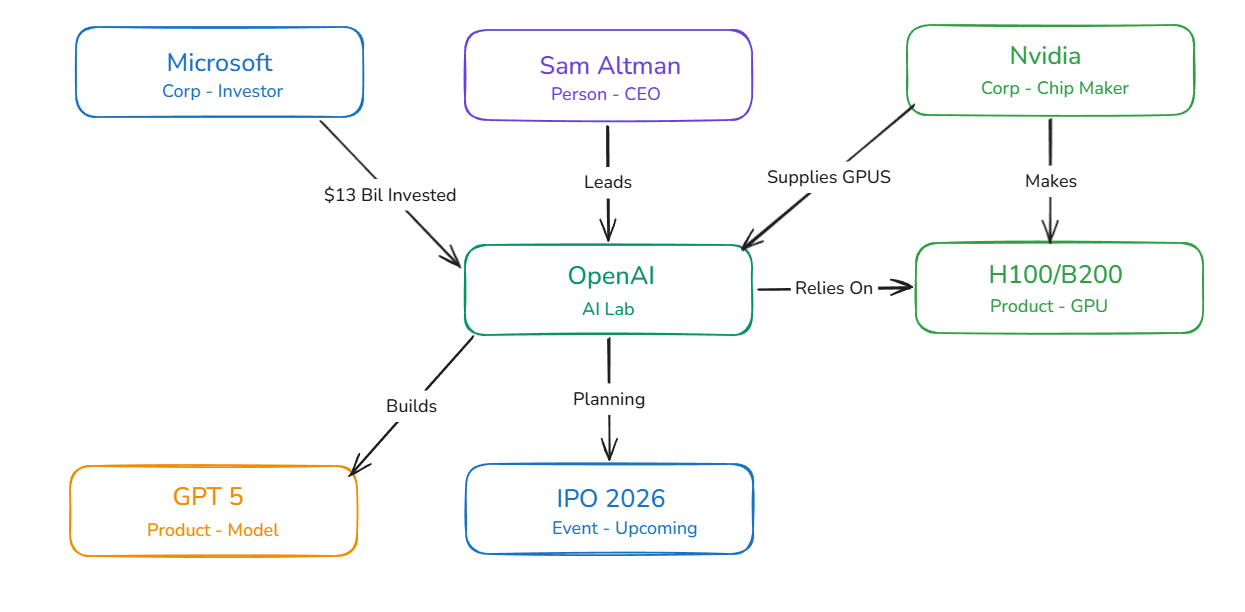 Simple Graph RAG Example
2. Create the Characters From that map, MiroFish generates thousands of AI agent "personas." Each one gets a distinct personality, a starting opinion, a background, and a social network, connections to other agents they trust, distrust, or are influenced by. These agents are not the same as the entities in the graph. Instead, they are simulated individuals who interpret and react to the world defined by the GraphRAG map.
3. Run the Simulation The agents are turned loose. They discuss, argue, persuade, and change their minds. The system runs parallel simulations, two independent digital worlds at once, and tracks how opinions evolve across time. This is where the "swarm intelligence" magic happens: complex, realistic-looking social dynamics emerge from thousands of individual interactions. The engine powering all of this is OASIS by CAMEL-AI. It can simulate up to one million agents simultaneously, and each agent behaves like a real social media user, they follow, comment, repost, like, mute, and search, just like you do.
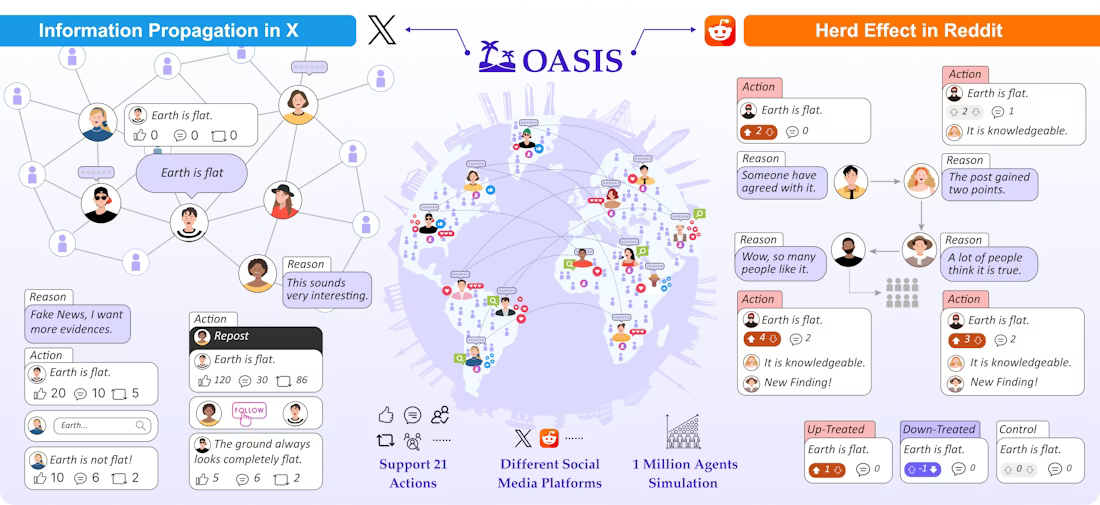 OASIS Camel AI Example Diagram Source
4. Generate the Report A dedicated "ReportAgent" analyses everything that happened across the simulation, how opinions shifted, which views gained traction, what coalitions formed, and produces a structured prediction report.
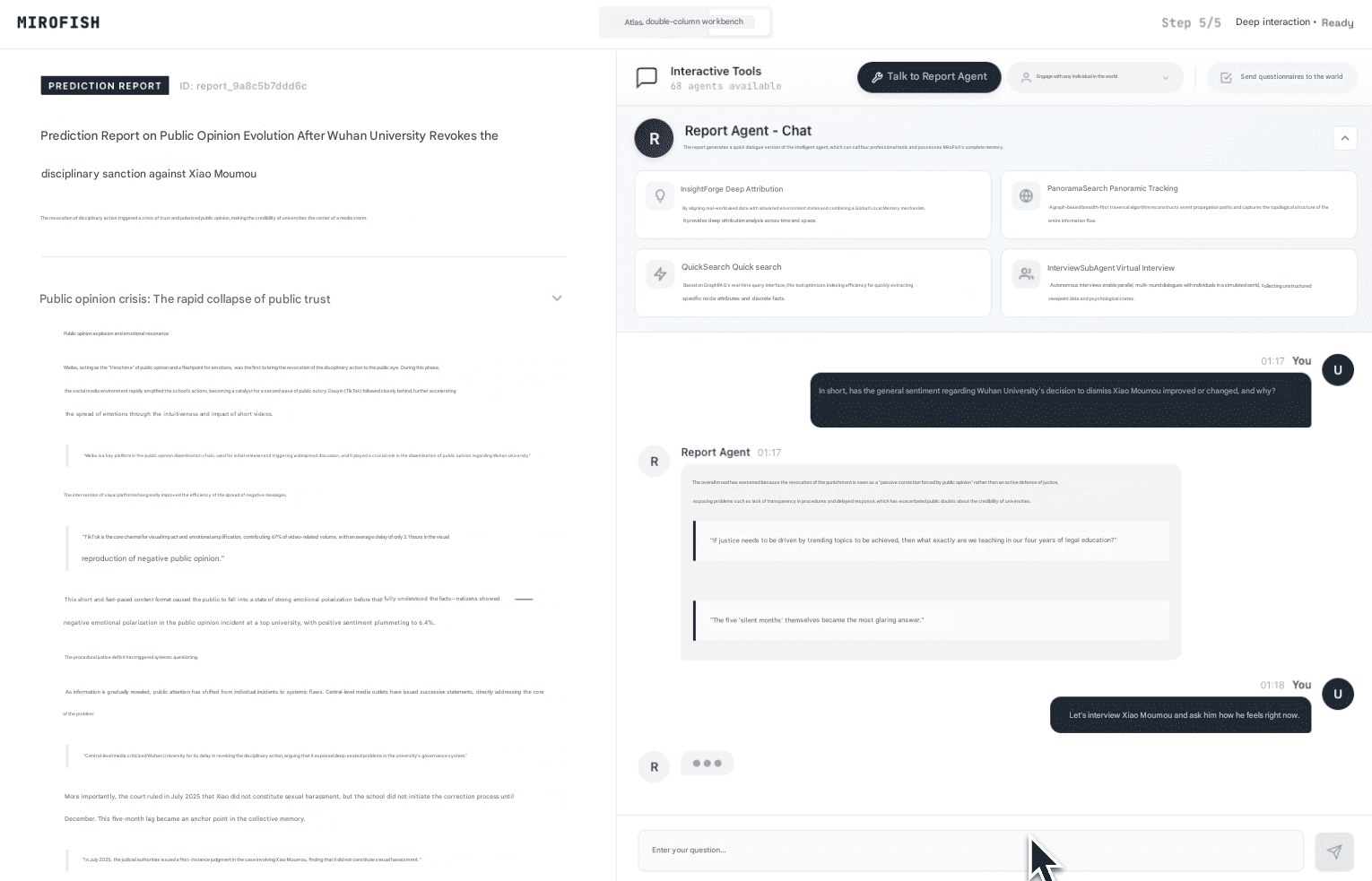 MiroFish Output Translated Source

5. Go Deeper Unlike most tools that hand you a PDF and call it done, MiroFish lets you keep going. You can chat directly with any simulated agent, probe the ReportAgent for alternative interpretations, or inject new variables and re-run entire scenarios. What if the CEO made a different statement? What if the policy rolled out a month later? You can keep testing it.
What Can It Actually Be Used For?
This is where things get exciting as MiroFish isn't built for a single industry and there could be a lot of applications for this. It's a general-purpose simulator for anything that involves human decision-making and social dynamics. Here are some of the most promising applications off the top of my head:
📈 Stock Market & Financial Strategy
This is perhaps the most immediately compelling use case. Markets aren't rational, they're driven by sentiment, narrative, and collective psychology of millions and billions. MiroFish can ingest financial reports, earnings announcements, or macro news and simulate how different investor types, analysts, and media voices are likely to react. For institutional investors and hedge funds, a tool that models crowd psychology rather than just price history could be genuinely valuable.
 Stonks Source
🃏 Polymarket and other betting apps
If you aren't already aware, companies like Polymarket and Kalshi are prediction market platforms that let users bet on outcome of real world events, such as economics, politics and sports. For example, people can bet on will the Washington Wizards win the 2027 NBA title (No they won't). Instead of guessing how the public will react to a new piece of economic data or a surprise political announcement, you could feed that information into MiroFish and simulate the response of thousands of agents before placing a position. Where does sentiment land? Does opinion shift quickly or slowly? Is there genuine disagreement or does the crowd converge fast? These are exactly the signals that determine how prediction market odds move.
 Me after running MiroFish before placing a bet Source
📣 Public Relations & Crisis Management
Imagine being a communications director who needs to decide how to respond to a damaging news story. Right now, that decision relies largely on instinct and experience. MiroFish offers something different: feed it your draft press release or your proposed response, and watch how a simulated public reacts before you hit send. Which communities get angrier? Which audiences are sympathetic? Where does the story spread? PR agencies and corporate communications teams could use this to stress-test messaging before it goes live, potentially saving companies from self-inflicted reputational disasters.
🏛️ Policy Testing & Government Decision-Making
Governments and policymakers are frequently surprised by how the public responds to new laws or regulations. MiroFish could simulate the rollout of a policy, housing reform, tax changes, public health measures, across a population of diverse, opinionated agents and identify friction points before a policy is announced. This kind of "social stress testing" could help governments design better communication strategies, anticipate backlash, or spot unintended consequences early. Although I'd prefer if they polled the citizens first instead.
🎯 Marketing & Product Launch Strategy
Before spending millions on a product launch, a brand could feed MiroFish their campaign materials and simulate how different demographic segments respond. Does the messaging land with younger audiences but alienate older ones? Does the pricing feel fair to the simulated public, or does it spark a backlash? Marketing teams could test dozens of variants in simulation before committing to real-world spend. This could be paired with whatever first-party data the company already has, past purchase behaviour, survey responses, email engagement, to make the simulation even more accurate.
Limitations
Don't worry, I'm not here to just be a hype machine. Although MiroFish is pretty cool, but it's still beta software and it would be doing you a disservice not to flag the rough edges.
It's Expensive to Run
This is probably the biggest practical barrier right now. Running a simulation with thousands of agents means thousands of LLM calls, and those add up fast. A reasonably sized simulation can burn through API credits quickly, which makes casual experimentation costly and large-scale use potentially prohibitive for individuals or small teams. Until either the underlying models get cheaper or MiroFish finds ways to optimise token usage, this is a real limitation.
 Mr Krabs - Spongebob Squarepants Source
There's No Benchmark Yet
One thing that's hard to ignore is that there's currently no standardised way to measure how accurate MiroFish actually is. With most AI tools you can point to benchmarks, test scores, accuracy rates, comparison studies. MiroFish doesn't have that yet. Until there's a rigorous way to measure simulation accuracy against real-world outcomes , it's difficult to know whether you're getting genuinely useful signal or a very convincing-looking hallucination. This is probably the limitation I'd most want to see addressed before using it for anything high-stakes.
Simulated Humans Aren't Real Humans
Another blocker is that the simulation are still AI characters responding to prompts, not actual people. They can miss cultural nuance, underrepresent fringe viewpoints, or reflect the biases baked into the underlying language models. The more niche or culturally specific your scenario, the less you should trust the output without sanity-checking it against real-world signals.
Outputs Are Probabilistic, Not Prophetic
MiroFish gives you a plausible simulation, not a guaranteed prediction. It's a thinking tool, not an oracle. It's not recommended to expect certainty, especially in high-stakes financial or policy decisions. Think of it less like a weather forecast and more like a really well-informed thought experiment.
Despite all of this, the core idea is strong enough that these limitations feel like when problems rather than if problems. Most of them are solvable with time, resources, and a growing open-source community behind it. We have witnessed how fast AI has improved over these short years so I have no doubt this tool will only get better with time.
Where Is This All Headed?
More agents, more fidelity. Developers have already run simulations with 500,000 AI agents in a single session. As the underlying infrastructure scales, simulations will get richer and more realistic, closer to true mirrors of real-world social dynamics.
Real-time data feeds. Right now, you upload a document and run a simulation. The next evolution I envision is continuous simulations fed by live data, news feeds, social media streams, market tickers, running 24/7 and updating predictions in real time. That's when this becomes something closer to a genuine forecasting infrastructure.
Domain-specific versions. Just as large language models have been fine-tuned for medicine, law, and finance, we'll likely see versions of MiroFish optimised for specific industries. A financial MiroFish trained on decades of market behaviour. A policy MiroFish calibrated on electoral data. Specialisation will make the predictions sharper and the tools more actionable for non-technical users.
Enterprise adoption. Most organisations that could benefit from MiroFish don't have the technical capability to run it themselves. As managed service providers wrap MiroFish in polished interfaces and reliable infrastructure, it will become accessible to communications agencies, investment firms, consultancies, and government departments, the same way cloud computing made enterprise software accessible to businesses that couldn't run their own data centres.
The deeper question: trust. The biggest open question isn't technical. It's epistemological. How much should decision-makers trust a simulation? MiroFish is a powerful thinking tool, a way to stress-test assumptions and explore scenarios, but it is not a crystal ball. The agents are AI, not humans, and simulated social dynamics are a model of reality, not reality itself. Used well, it augments judgment. Used poorly, it could create false confidence. As adoption grows, so will the need for frameworks around how to interpret, challenge, and responsibly act on simulation outputs.
Summary
MiroFish is remarkable, not just as a piece of software but as a sign of the times. A 20-year-old student, working largely alone with AI coding tools, built something in ten days that is being compared to the output of entire research teams at the world's biggest technology companies. I definitely can't let my Asian mother find out he exists as I will never hear the end of it.
Whether or not MiroFish itself becomes the dominant tool in this space, the category it represents — swarm intelligence simulation as a decision-making aid — is most likely here to stay in my opinion. The potential ability to rehearse the future before committing to it is too valuable to ignore.
MiroFish is open source and available at github.com/666ghj/MiroFish if you want to check it out (It's in Mandarin). Their website is mirofish.ai.